

Many people, including fellow medical/healthcare professionals or parents are not familiar with what an Athletic Trainer is or what we in the profession do. I cannot begin to tell you how many times I have had to give my elevator speech to someone to explain how we are not personal trainers, but actually licensed healthcare professionals that work on injury prevention, injury management, and rehabilitation of injury! Which I think is sort of comprehensive when it comes to a job description for an AT. But, even though we are moving to a Professional-level degree with the Masters it does not change the over all view of our abilities. Fortunately, there is research backing up our capabilities in healthcare professions to effectively and properly diagnose. Lombardi et al (2016) published a study that found over the window of 2010 to 2015 across 5 regional high schools that the Athletic Trainer’s and Physician’s (MD or DO) diagnosis were the same 92% of the time! That’s right, a Bachelors educated healthcare professional’s prognosis was the same as an MD’s or DO’s 92% of the time, and when it wasn’t it was a mismatch between sprain and fracture (cool, I do not know a single AT that has an MRI or Radiograph on the sideline, so I will take that small loss).
Thus, it is safe to say that Athletic Trainers are spot on when it comes to concussion diagnosis. But, this brings us to discussing how then can an AT best design their sideline assessment to accurately capture a concussion diagnosis and potentially save lives… After all, according to the 5th International Consensus Statement on Sports Related Concussions (2017):
“SRC is considered to be among the most complex injuries in sports medicine to diagnose, assess and manage. (McCroy et al, 2017)”
Creating the perfect, timely, and most comprehensive sideline assessment of concussions is not easy, by any means. As we are beginning to learn, no single test is perfect and no single test should be used alone to establish a patient’s/athlete’s concussion diagnosis (McCroy et al, 2017; Broglio et al, 2014). Thus, the Athletic Trainer must develop a battery of tests that can be confidently and quickly administered to established the patient’s status on the sideline. After a good deal of review of the items out there, here is what I have come up with and implemented at my clinical setting:
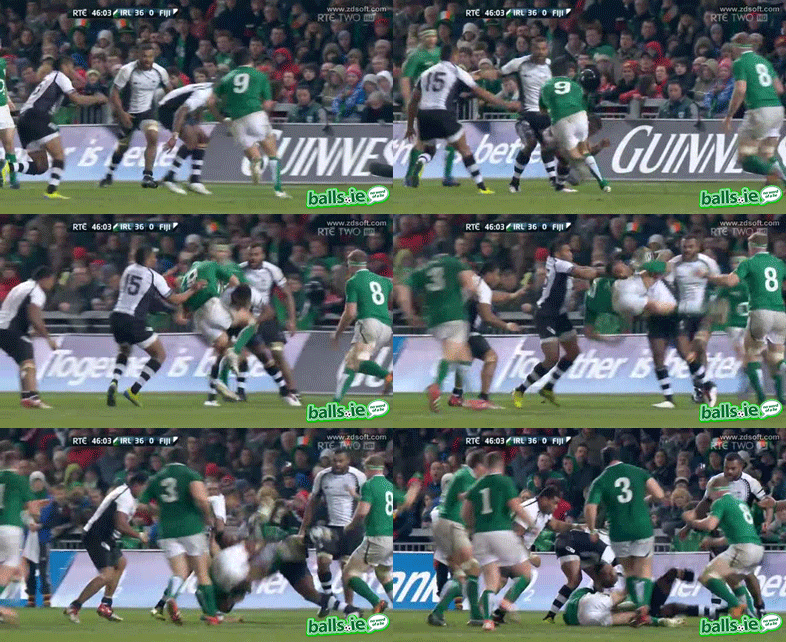
Let’s set the stage with the AT is covering a football game when they see one of the Student-Athletes experience one of the multiple mechanism of injuries (MOIs) consistent with concussion, even better allow me to describe a likely one: The Wide Receiver takes off the line a clears his defender. He gets open about 20 yards off the line and the quarterback launches the football to him. The ball is a little high so he leaps into the air to catch the ball with his upper torso rotated to align with the catch. He receives the ball in the air with his eyes back where the ball was coming from. He does not see the opposing team’s Free Safety coming in who makes the hit before the Wide Receiver makes it back to the ground. The Wide Receiver hits the ground with his shoulders then helmeted-head and does not get up. Or any of these real-life examples:


With this scene set, we have a few of the rotational-translations to the skull MOIs occurring, once on the initial hit to the Wide Receiver, another occurs when his head hits the field and there is potential of a third on rebound. Moral of the story, that is a solid MOI for concussion.
So here goes the sideline eval:
The Athletic Trainer does the AT-Jog out to the patient who is still on the ground and establishes consciousness (Glascow Coma Scale or GCS) and cognitive awareness with some light history questions.
- Check the patient’s neck in accordance with the SCAT5 procedures in order to rule out any fractures.
- Ask the patient if they have any numbness or tingling into the hands or feet, ask them to move them if possible in order to rule out neurological damage.
- At this point if there are no concerns we can move them to the sideline, if there are concerns then we are activating EMS/EAPs respectively.
- On the Sideline the AT would start by taking vitals for Heart Rate, PulseOx, BP, etc. This will be important for serial testing to know if the patient is getting worse or circling the drain as it were.
- Once vitals are done, its time for Post Concussion Symptom Scores (PCSS) and Maddox Questions. These are part of the SCAT5 and can be used to established symptom sets.
- If they have no symptoms at this time, then the patient would be exertionally tested for a few minutes to see if the symptoms return. This could include burpees, sprints, change of direction, and other drills that should elicit symptoms in a potentially concussed patient.
- If this elicits symptoms they will continue to the sideline battery assessment.
- If they have no symptoms after exertional testing, then they are returned to play with no diagnosis of concussion.
- If they do have symptoms then we continue along to our sideline battery
- If they have no symptoms at this time, then the patient would be exertionally tested for a few minutes to see if the symptoms return. This could include burpees, sprints, change of direction, and other drills that should elicit symptoms in a potentially concussed patient.
- The sideline battery consists of a Cranial Nerve Assessment to rule out more
serious injuries, the remainder of the On-Field SCAT5, and the VOMS Screening.
- At my institution, VOMS was chosen over the King-Devick Test only because of the cost associated to the King-Devick Test, in my own personal opinion I must stress that I believe the K-D Test to be very strong and much faster than VOMS, it also produces more objective data than VOMS that can be used to justify diagnosis of concussion.
- If the patient is no longer demonstrating ANY symptoms or deficits in assessments, they will be exertionally tested as before, if they pass exertional testing without symptoms then they will be returned to play with no diagnosis of concussion.
- If the patient fails any of the evaluations or the AT feels there is something not right, then they will be moved to Off-Field assessments and serial tested for potential degradation of status.

I personally believe this is an ideal and comprehensive sideline evaluation for concussion. Due to the fact that some sports have limited injury time and the nature of game play, it is important for ATs to be both timely and comprehensive in their evaluation of a patient for concussion. No matter what, the AT should feel confident in their sideline assessment and practicing the routine will always help in making it flow easy and timely.
By: Jeremy D. Howard, MS, LAT, ATC, CSCS, CES, PES, ITAT
References
Broglio, S.P., Cantu, R.C., Gioia, G.A., Guskiewicz, K.M., Kutcher, J., Palm, M., and Valovich McLeod, T.C. (2014). National athletic trainers’ association position statement: Management of sport concussion. Journal of Athletic Training, 49(2), 245-265.
Lombardi, N.J., Tucker, B., Freedman, K.B., Austin, L.S., Eck, B., Pepe, M., and Tjoumakaris, F.P. (2016). Accuracy of athletic trainer and physician diagnosis in sports medicine. Orthopedics, 39(5), e944-e949.
McCroy, P., Meeuwisse, W., Dvorak, J., Aubry, M., Bailes, J., Broglio, S., …, and Vos, P.E. (2017). Consensus statement on concussion in sport– the 5th international conference on concussion in sport held in Berlin, October 2016. British Journal of Sports Medicine, 0, 1-10.


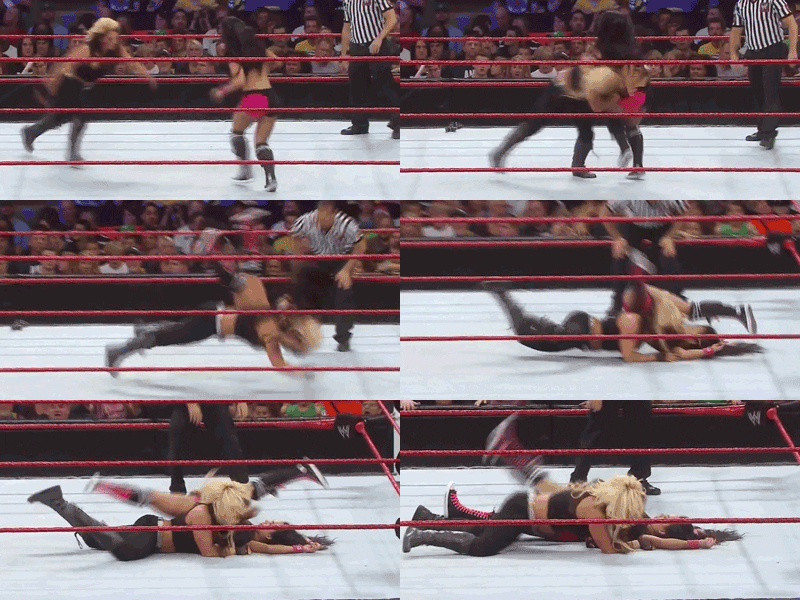


 yet maintain the integrity of the sport for what it is? Can we truly remove tackling from the sport? Syd and Johnson (2012) suggested that due to the major differences in athlete size up until the age of 16 (see picture below for reference), and considering only 6% of American Football players will go on to play Collegiate ball while only 0.08% will ever make it to pro-level, that we could tentatively remove tackling from youth football. They suggest teaching the skills and drills of tackling sub-16 years old, gradually bringing them to full contact football. This would fall in-line with current best practices recommended by the American Academy of Pediatrics recommendations for ice hockey and body checking. But, would making this change be received well?


 external portions of the head, it has no chance of protecting the brain against any of the proposed mechanisms of injury that have been known to cause concussion, the coup-contrecoup, axonal torsion, concussive blast, or even non/sub-concussive cumulative impacts. No matter how much padding you put around the head it wont stop a concussion!


 for Soccer. The designer posed the idea and claims that it will decrease concussions by something like 50%… Dr. Cantu (we will cal him the man when it comes to Concussion research), tears the product to pieces. Aside from Dr. Cantu’s expert opinion, just listen to the video and it is ripe with inconsistency on the product preventing concussion. The video highlights Natasha Helmick, a women’s soccer player that played on the Olympic Development Team before being forced to quit the sport from a high frequency of concussions (5 after starting to wear the Full 90). Worse off… she had to drop out of college due to the long-term effects of her extensive concussion history.

 not the artery, thereby increasing the density and viscosity of the fluids protecting the brain. The effects are less sloshing of the brain back-and-forth during impacts. This is an awesome idea when looking at the levels of G-forces experienced in sport during impacts. According to Broglio et al (2011), over an 8 year period of 4 years of starting high school football and 4 years starting college football, a player is expected to have over 8,000 head impacts, with a


 both athletics and academic scholarships. All of these potentially affect the long-term goals of student.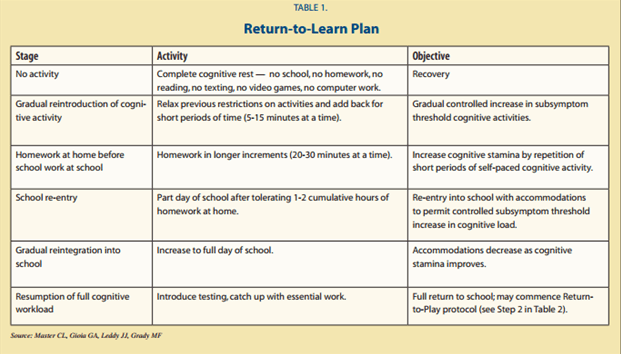
 motion. The issue surrounding this is that the symptoms associated to a concussion typically subside after 7-10 days (McCroy et al, 2017), and due to state-variance in the 504 process the student-athlete may already be recovered by the time the official 504 is put into effect to protect their recovery needs. Further, collegiate student-athletes do not fall under the 504 or IEP process, these student-athletes have a separate process at the institution of learning.


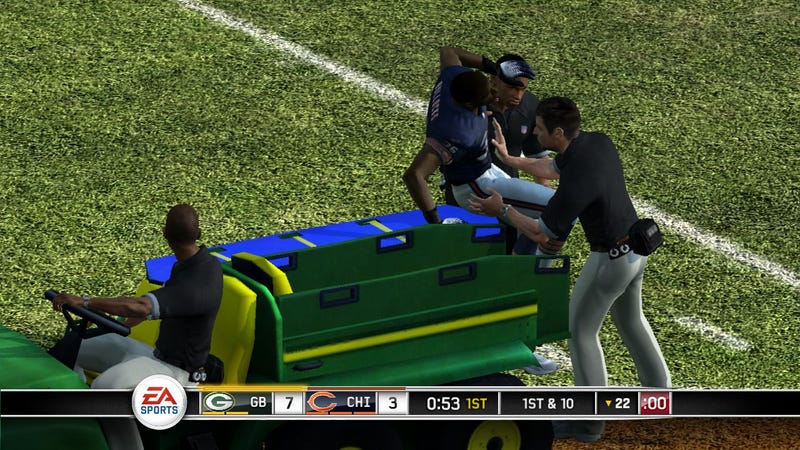 franchise alone, not taking into account NHL, FIFA, or other sports games on the market, it isn’t hard to see how proper portrayal of concussions in these games could assist in concussion education by creating a cultural framework to build upon.
 This level of exposure is an amazing step in the right direction for concussion awareness worldwide. To further show that the NFL isn’t the evil creature that they are portrayed to be, Robinson (2014) in a Sports Illustrated article pointed out that while the NFL and EA decided to remove the fan-favorite and famous Madden Ambulance, the NFL also provided EA with
  accurate frequency data on concussions so they could properly include them for realism, as well as, using proper verbiage like head injury, over “Bell Ringer” or “Ding”.


 At this point most of us have seen either Will Smith’s Concussion movie or the


 advancement in concussion research and policy. Currently, there is a large push for donations to the
 A third major action the Concussion Legacy Foundation is taking is their






 inevitable question that follows, “Now what?”. Parents, athletes, coaches, general managers, everyone always wants to know what happens once an athlete sustains a concussion. This article provides you with some answers to that burning question.
 No. Rest is still a vital portion of the treatment regime for athletes with concussions, but the amount of rest needed for cognitive repair is a widely debated and researched topic. In order to better care for a concussed athlete, the healthcare provider must find a balance between limited physical and cognitive exertion and rest. ‘Total Rest’ is considered to be the most beneficial during the first 72 hours following a concussion, the subacute . This allows those interacting with the individual to monitor and observe changes in behavior possibly associated with SDH and EDH. As an athlete ventures past the subacute phase and into the recovery phase, the athlete should be subjected to increased loads of mental exertion while being cautious of the amplification of concussion symptoms. A normal daily routine allows the athlete to receive cognitive modifications as well as not missing out on academic responsibilities.

 Let’s start with the
  one study addressing CogSport and Sensitivity and Specificity, which they stated found that 70.8% of the tested athletes demonstrated deficiencies in their tests. while this is not necessarily as comparable to the research done on the ImPACT, it is valid information to know. With regard to Reliability, there were a few studies done and the ranges were from 0.14 (very weak)-0.94 (strong), this is a good deal of variability in the reliability. However, Resch’s research article does stress that each category did hit the bare minimums, at least, to qualify in the categories of measure. Finally, addressing validity Resch’s review of the literature found a range of 0.23-0.83 depending on the research study, also a huge swing.
 Then there is the

 movie Concussion brought attention to the concern. When I think about the casual link being seen between a history of concussion, a mTBI, and this potentially leading to CTE, I cannot help but draw the conclusion that it must be on a similar spectrum as the link we are seeing between a history of military-related TBI and PTSD. This author and Sports Medicine Professional believes additional research should target this population to see if any findings from either side can assist the other, NFL or military. In the need to do better by not just our athletes but our Service Member and Warfighters; after all, not all wounds are visible!


